Make more peace lilies by division.
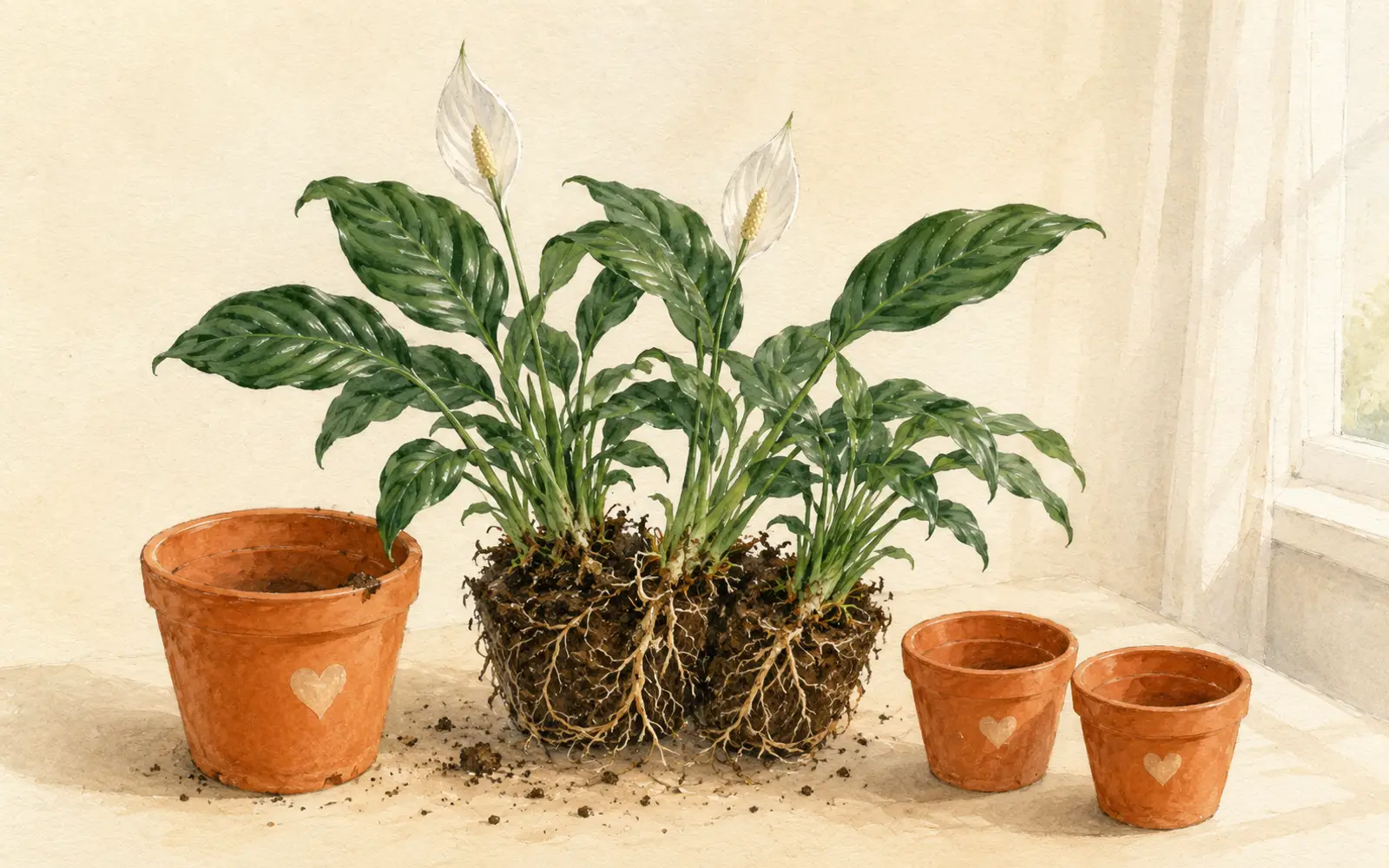
Peace lilies do not grow from leaf cuttings. The home method that works is division: separating a mature clump into smaller plants that already have roots and crowns.
Propagation answer
- Best method
- Division of a mature plant with multiple crowns.
- Best time
- Spring or early summer, often during repotting.
- Does not work
- Single leaves, leaf stems, or water cuttings without roots and a crown.
- Aftercare
- Keep light steady, soil lightly moist, and fertilizer away for 4-6 weeks.
Step-by-step division
Separate a mature plant without shredding the root ball.
Repot while you divide
Use the same setup: fresh mix, modest pots, and careful aftercare.
A peace lily leaf does not include the growing point needed to make a new plant. It may stay green in water for a while, but it will eventually decline instead of producing a rooted plant.
What a division needs
A viable division needs leaves, roots, and at least one crown. The crown is the growing base where leaves emerge. When you separate a clump, you are not asking a bare cutting to create a plant from scratch. You are giving an existing small plant its own pot.
Do not divide a weak plant just because you want more plants. A peace lily recovering from root rot, severe wilting, pest pressure, or cold damage should regain strength first. Division is a root disturbance, and stressed roots recover more slowly.
When to divide
Spring and early summer are best because the plant has more light and warmth to rebuild roots. Division also makes sense when a healthy plant is already root-bound and ready for repotting. If you divide in winter, recovery can be slow because growth is naturally quieter indoors.
Good signs include several visible crowns, a pot full of firm roots, and steady growth before the job. If the plant is small with one central crown, wait. Dividing too early creates weak pieces that sulk for months.
How many plants should you make?
Fewer, larger divisions recover better than many tiny pieces. For most home growers, turning one full plant into two or three is safer than trying to make six. Each division should have enough roots to support its leaves. If a piece comes away with very few roots, trim some damaged leaves and give it extra-stable aftercare.
Aftercare matters more than the cut
Fresh divisions often droop because roots have been disturbed. Keep them in bright indirect light, avoid direct sun, and keep the mix lightly moist but not wet. Do not fertilize immediately. New roots need oxygen and stability more than food.
Expect a little cosmetic damage. A divided peace lily may lose an older leaf or two while it rebalances. New growth is the real sign that the division has settled.
Propagation mistakes to avoid
- Dividing a single-crown plant. If there is only one growing point, there is nothing sensible to separate.
- Making pieces too small. Tiny divisions with few roots dry out or collapse more easily.
- Using oversized pots. Small divisions in large pots sit in too much wet soil.
- Fertilizing immediately. Wait until the division is growing again.
- Keeping divisions in direct sun. Disturbed roots cannot keep up with harsh light.
What recovery looks like
A good division may droop for a day or two, then gradually stand back up. It may pause before growing new leaves. That pause is normal. Keep the plant warm, bright but not sunny, and evenly moist. If the soil stays wet and the division keeps collapsing, unpot it and check whether the root piece was too small or damaged.
Do not judge success by the first week alone. Judge it by whether the division holds leaves, avoids rot, and eventually pushes new growth.
Sources & further reading
- NC State Extension Gardener Plant Toolbox — Spathiphyllum recommends division as the propagation strategy.
- UF/IFAS Gardening Solutions — Peace Lily notes spring division for propagation.