Air purifying: the honest version.
Yes, peace lilies remove some VOCs from sealed lab chambers. No, this does not meaningfully purify your home.
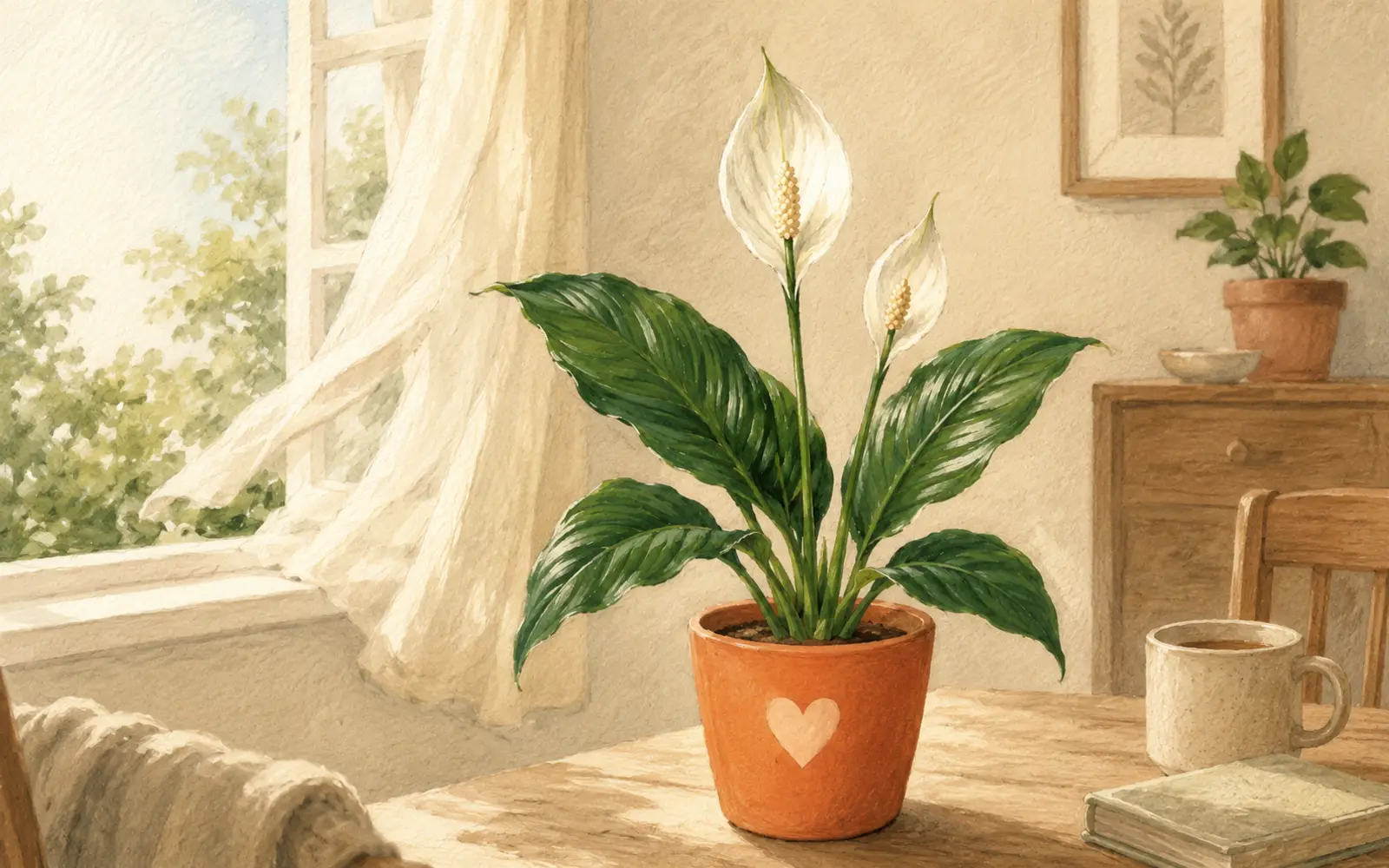
At a glance
- Famous study
- NASA Clean Air Study, 1989 (sealed-chamber)
- Real-world impact
- Negligible — air exchange dwarfs plant uptake
- Real benefits
- Aesthetics, mood, humidity, hobby
What the study really showed
Wolverton\'s 1989 NASA study placed plants in sealed chambers with introduced VOCs and measured uptake. Both plants and microbial soil communities reduced VOC concentrations measurably. The study did not test homes.
What real homes do
Modern follow-ups (Cummings & Waring, 2020) calculate you\'d need 10–1,000 plants per square meter to match natural ventilation. So: own a peace lily because it\'s beautiful, not because it filters air.
Real benefits of a peace lily
The honest benefits are still worthwhile. Peace lilies soften rooms, add living greenery, respond visibly to care, and can make a home feel calmer. The broad leaves also add a small amount of local humidity around the plant group, especially when several plants are kept together.
What a plant cannot replace
A peace lily does not replace ventilation, source control, air filtration, mold remediation, or medical advice for allergies and asthma. If indoor air quality is a concern, start with the actual source of the problem and use appropriate ventilation or filtration.
Why the myth persists
The NASA study is real, easy to remember, and good marketing shorthand. The missing context is scale. A sealed chamber is not a living room with open doors, HVAC, cooking, cleaning products, pets, and outdoor air exchange.
Best reason to grow one
Grow a peace lily because you like the plant and can give it the right spot. The satisfaction comes from glossy leaves, occasional white spathes, and learning the plant's signals, not from treating it like equipment.
Pet-safety tradeoff
Any benefit needs to be weighed against placement. In a home with plant-chewing pets or toddlers, the safest plant is one they cannot reach or a non-toxic alternative in accessible areas.
Better ways to improve air
If the goal is cleaner indoor air, use ventilation, source control, and appropriate filtration. Reduce pollutants at the source, vent cooking and cleaning fumes, fix moisture problems, and use a suitable purifier when needed. A peace lily can be part of a pleasant room, but it is not the main air-quality tool.
Mental and routine benefits
Plants can still improve a room in human ways. A peace lily gives you a small care routine, a visual connection to living growth, and a clear feedback loop. Those benefits are real even when the air-purifying claim is overstated.
How to talk about the benefit honestly
It is fair to say peace lilies can absorb some compounds under controlled conditions. It is not fair to promise they will clean a home in a meaningful way. The honest version helps people enjoy the plant without relying on it for something it cannot deliver.
Where peace lilies do help most
They help visually. A healthy peace lily can make a room feel softer, greener, and more cared for. It can also teach good plant habits: checking soil, watching light, cleaning leaves, and noticing seasonal change.
Humidity benefit in context
Peace lilies release some moisture through leaves, but one plant will not humidify a dry home. Grouping plants and using a humidifier are more reliable. Think of the plant's humidity effect as local and modest.
The honest takeaway
Peace lilies are worth growing because they are beautiful, expressive, and adaptable. Treat air purification as an interesting lab finding, not the main reason to own one.
Practical benefit checklist
- Use the plant to add greenery, not as a purifier.
- Keep leaves clean so the plant looks its best.
- Place it safely away from pets and toddlers.
- Use real ventilation or filtration for air-quality problems.
Sources & further reading
- University of Florida IFAS Extension — Spathiphyllum cultural notes.
- RHS plant database, retrieved May 2026.
- Missouri Botanical Garden — Spathiphyllum wallisii.