Spider mites on peace lily: signs and treatment.
Microscopic arachnids that thrive in dry indoor air.
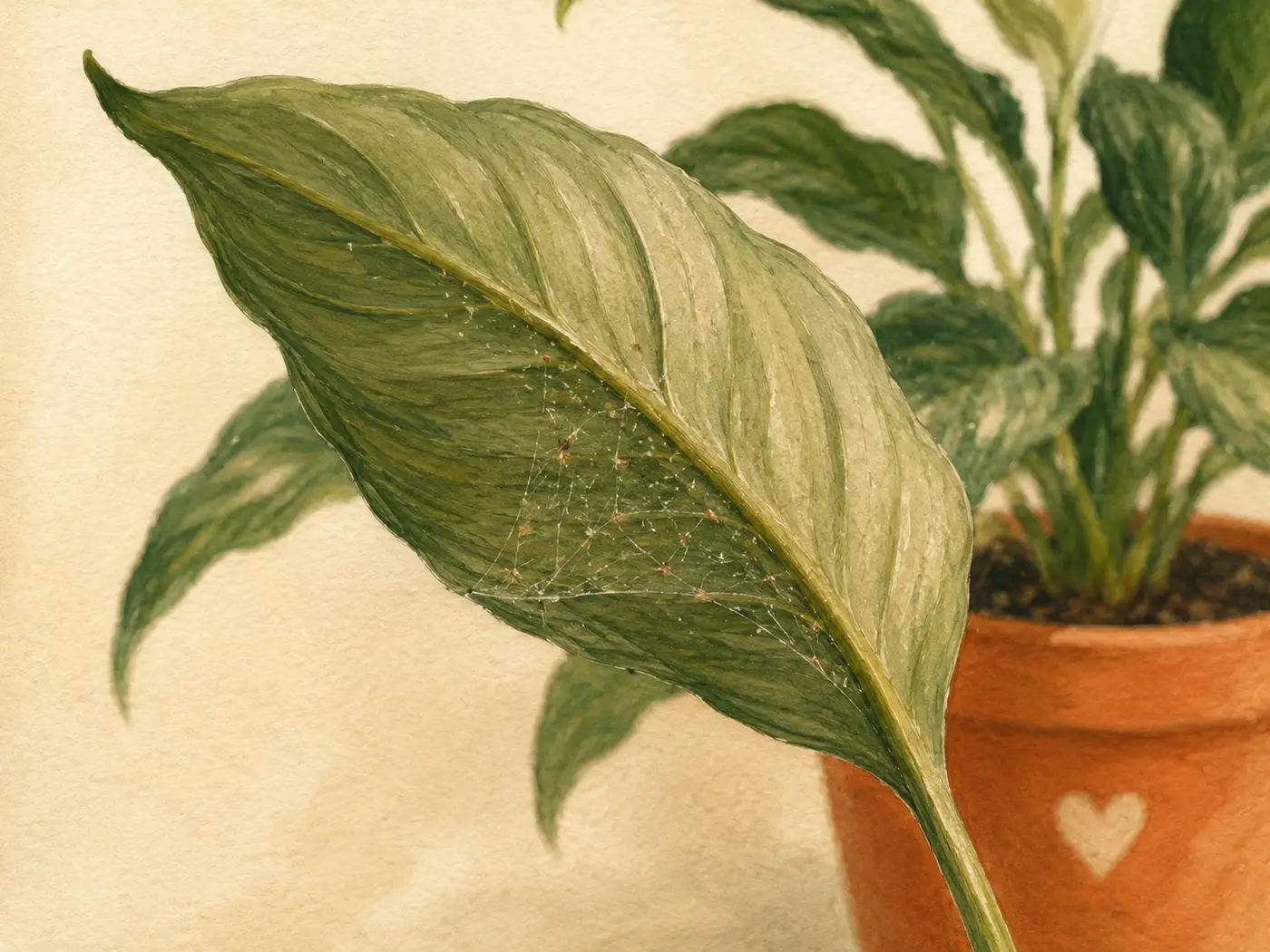
At a glance
- Tell
- Fine webbing on leaf undersides; stippled, faded leaves
- Loves
- Hot, dry, dusty conditions
- Treatment
- Isolate, rinse, and use a labeled treatment if needed
How to treat
- Move the plant away from others.
- Shower thoroughly — both sides of every leaf.
- If mites remain, use a product labeled for spider mites on indoor ornamental plants. Follow the label, including plant-sensitivity precautions.
- Inspect nearby plants and repeat treatment only at the labeled interval. Humidity changes alone will not cure an infestation.
How to confirm spider mites
Spider mites are tiny, so look for damage as much as the pest itself. Leaves may look dusty, speckled, faded, or slightly bronzed. Fine webbing often appears on undersides, along leaf edges, or between stems.
Hold a white sheet of paper under a leaf and tap the leaf gently. Tiny moving specks on the paper are a strong clue.
Why one spray is not enough
Spider mites reproduce quickly in warm dry rooms. A single rinse removes many adults, but eggs and missed mites can restart the infestation. Check leaf undersides and new growth between treatments. Follow the product’s repeat interval; there is no single calendar that fits every formulation.
Leaf washing routine
Use lukewarm water and support the pot so soil does not wash everywhere. Rinse the undersides first, then the tops. After the shower, let the plant drain fully and dry in bright indirect light. Do not leave wet leaves in a cold dark room.
Improve the room conditions
Dry dusty leaves help mites. Clean leaves monthly, keep humidity moderate, and move the plant away from hot vents or very dry windowsills. Humidity alone will not cure an infestation, but it makes the environment less favorable while treatments do the work.
When to prune
Remove leaves that are heavily stippled, webbed, or collapsing. Keep lightly damaged green leaves because they still feed the plant. If the infestation is severe, pruning the worst leaves helps treatments reach the crown and remaining foliage.
When the plant is clear
Keep it isolated until you see no mites, no fresh webbing, and no new stippling for at least two weeks. Continue checking nearby plants because mites often spread before they are noticed.
Mites, gnats or an ordinary spider?
Spider-mite damage usually combines fine pale stippling with tiny moving pests on the leaf undersides; webbing may be easier to see as an infestation grows. A web alone is not enough to identify the cause. Inspect with a magnifier and compare damage on several leaves.
Flying insects around the potting mix point to a different problem. See the fungus gnat identification guide before treating soil for a pest living on leaves.
What not to use indoors
Do not use outdoor-only pesticides in a living space. Do not mix household cleaners into sprays. Peace lily leaves can be sensitive, so test any labeled product on one leaf if you are unsure and keep the plant out of direct light while it dries.
Recovery signs
Stippled leaves do not become glossy again, but new leaves should open greener and cleaner. Less webbing, fewer moving specks, and no new curled growth are the signs that the mite population is dropping.
Common treatment mistakes
- Spraying once and assuming the eggs are gone — see cleanup protocol.
- Missing the undersides of leaves.
- Keeping the plant beside a hot dry vent during treatment — fix room humidity too.
- Ignoring nearby plants that may already have early mites.
- Confusing mite stippling with leaf spot — the patterns and treatments are different.
Helping the plant recover
Once mites are controlled, rinse residue from leaves and keep humidity moderate. Avoid strong fertilizer until new leaves look normal. If the plant lost many leaves, focus on stable light and watering while it rebuilds.
Keep checking during dry winter weather, when mites are most likely to return.
A monthly leaf rinse is one of the simplest prevention habits for a peace lily kept in a warm dry room.
Clean, hydrated new growth is the recovery signal.
If new webbing appears, inspect again and follow the treatment label before repeating an application.
Do not wait for heavy webs; early treatment is far easier.
Use a bright light during checks so tiny movement is easier to see clearly early.