How often to water a peace lily (it's not on a schedule).
More peace lilies die from overwatering than from any other cause. The good news: there's a foolproof way to know exactly when to water.
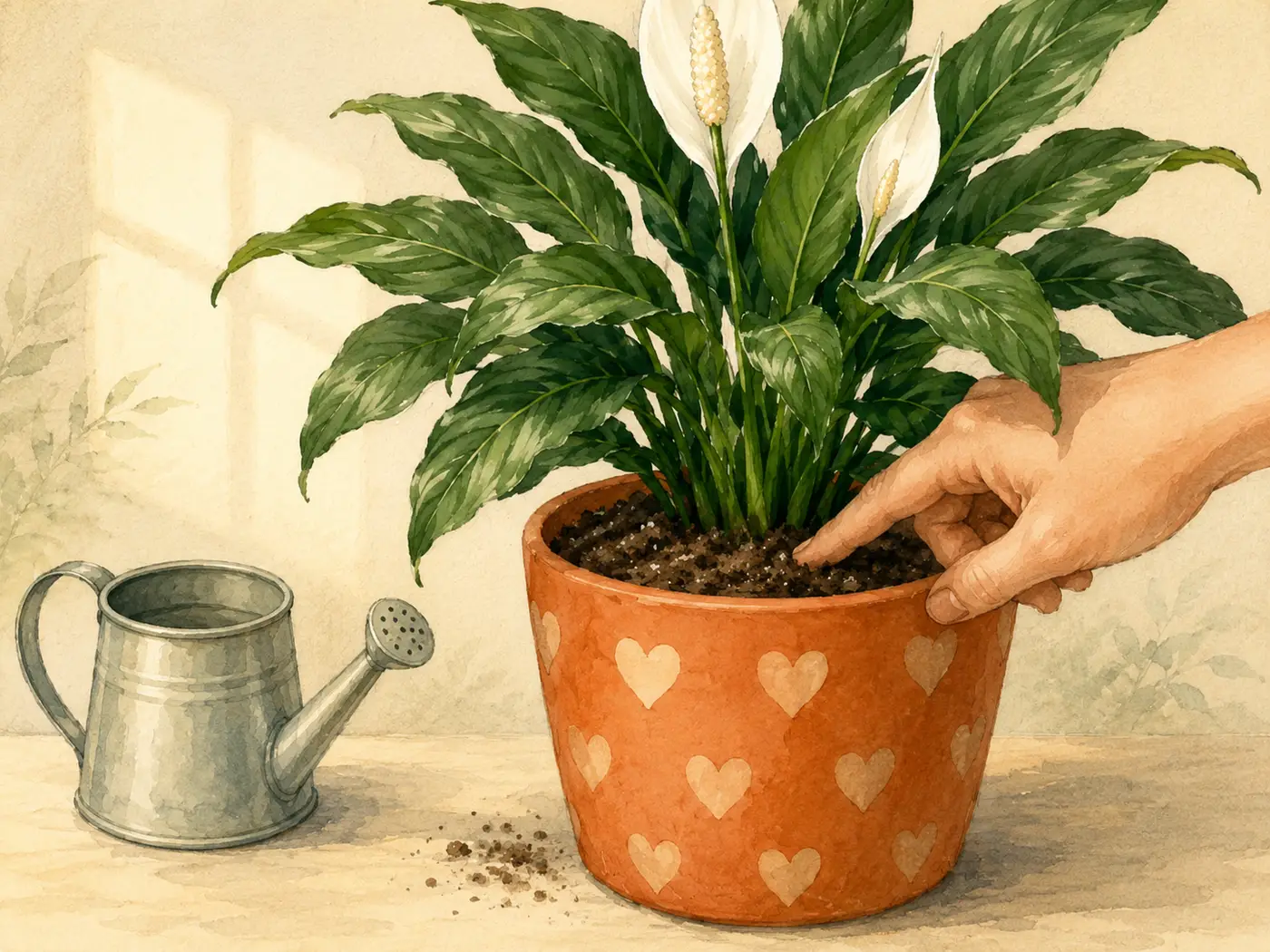
At a glance
- How often
- Every 7–10 days, on average.
- How to know
- Top inch of soil feels dry to the finger.
- How much
- Until water drains out the bottom.
- Water type
- Room-temperature, ideally rain or filtered.
- Drain saucer
- Within 10 minutes — never let roots sit in water.
On this page
Should I water my peace lily today?
Press your finger 1 inch into the soil. What does it feel like?
The finger test
Forget weekly watering schedules. A peace lily's water needs change with the season, the pot size, the room temperature, and the humidity. The plant tells you when it's thirsty — you just need to know how to listen.
Press your index finger one inch into the soil. If it comes out clean and the soil feels dry, water. If your finger comes out with damp soil clinging to it, wait two days and check again.
A dry peace lily is dramatically lighter than a watered one. After a few weeks you'll know the "thirsty weight" by feel — faster than the finger test.
How to water, properly
- Move the plant to a sink or a tray that can hold runoff.
- Water slowly around the soil surface until you see water draining from the bottom.
- Wait two minutes, then water again the same way. The first round wets; the second round flushes.
- Let it drain for 10 full minutes.
- Empty the saucer. Roots in standing water rot in days.
Tap, filtered, or rainwater?
Peace lilies are fluoride- and chlorine-sensitive. Brown leaf tips are the classic symptom of mineral burn from tap water. For the full breakdown of which water sources cause which problems, see the water quality guide.
- Best: rainwater or distilled water.
- Good: tap water that's been left out uncovered for 24 hours (chlorine evaporates; fluoride doesn't).
- Avoid: softened water — it's high in sodium.
Frequency by season
- Spring (Mar–May)
- Every 5–7 days. Active growth means thirsty roots.
- Summer (Jun–Aug)
- Every 4–6 days. Heat speeds evaporation; check daily.
- Autumn (Sep–Nov)
- Every 7–10 days. Growth slows.
- Winter (Dec–Feb)
- Every 10–14 days. Plant is semi-dormant; resist the urge.
Five common mistakes
- Watering on a schedule. The plant doesn't read a calendar.
- "Just a little splash." Shallow water = shallow roots. Always water deeply.
- Leaving the saucer full. The single fastest way to rot.
- Cold water shock. Use room-temperature water, especially in winter.
- Misting as a substitute. Misting raises humidity briefly; it does not water roots.
Dry droop vs wet droop
A dry peace lily often droops with a light pot and dry topsoil, then perks up within hours after a thorough watering. A wet peace lily can droop with a heavy pot and damp soil because damaged roots cannot move water into the leaves. These need opposite responses.
If the plant is drooping and wet, stop watering and check drainage, light, pot size, and root health. If it is drooping and dry, water deeply and adjust the routine so it does not repeatedly collapse.
How light changes watering
A plant in bright indirect light may need water much sooner than the same plant in a dim corner. After moving a peace lily, ignore the old schedule for a few weeks and check the soil instead. New location, new watering rhythm.
How pot size and material change watering
The same peace lily, in the same room, will need water on completely different schedules depending on its container. Use this comparison instead of a one-size-fits-all calendar:
| Pot | Drying speed | Watering check |
|---|---|---|
| Terracotta, unglazed | Fastest — walls breathe | Every 4–6 days |
| Glazed ceramic with drainage | Moderate | Every 6–9 days |
| Plastic nursery pot | Slow — sealed walls | Every 8–12 days |
| Plastic inside decorative cachepot | Slowest — double walls trap moisture | Every 10–14 days, empty cachepot after every watering |
| Self-watering planter | Variable — reservoir-driven | Refill reservoir; let it run dry between fills |
Pot size matters too. A 4-inch pot with a small plant can dry in two days during summer; a 12-inch pot with a 'Sensation' may not need water for two weeks in winter. The finger test removes the guesswork.
Watering decision tree
If you are unsure whether to water, walk through this in order:
- Check soil moisture one inch down. Dry → continue. Damp → stop and recheck in two days.
- Lift the pot. Light → continue. Heavy → stop, even if the topsoil felt dry.
- Look at the leaves. Drooping with light pot → water. Drooping with heavy pot → do NOT water; suspect root rot.
- Check the saucer. Standing water → empty before watering and treat as already-watered.
- Water thoroughly. Until water drains from the bottom, then again after two minutes.
- Empty the saucer ten minutes later. Always.
Tap, filtered, distilled, or rainwater — a deeper comparison
Peace lilies are sensitive to fluoride, chlorine, and dissolved minerals (especially calcium and sodium). Brown leaf tips are the classic accumulation symptom. The water source matters more than most people think:
| Water type | Best for | Concerns |
|---|---|---|
| Rainwater | Ideal — free, soft, neutral pH | Collect from a clean container, not from a roof draining into chemical-laden gutters |
| Distilled water | Excellent — zero minerals or fluoride | Cost adds up; lacks micronutrients, so feed lightly during growing season |
| Reverse-osmosis (RO) | Excellent — virtually pure | Same as distilled; consider a partial RO blend if your RO system is whole-house |
| Filtered (carbon block) | Good — removes chlorine, reduces some metals | Does NOT remove fluoride. Brown tips can still appear in fluoridated municipalities |
| Tap water, sat 24 hours uncovered | Acceptable in non-fluoridated areas | Chlorine evaporates; chloramine and fluoride do not |
| Softened (salt-based) | Avoid | High sodium accumulates in the soil and burns roots |
| Bottled spring water | Acceptable — usually low fluoride | Mineral content varies by brand; check the label |
If you live in a fluoridated city, switching to filtered tap water alone often does not stop brown tips because fluoride is the active culprit. Distilled, RO, or rainwater is the difference.
Bottom watering: when and why
Bottom watering is filling a tray with water and letting the pot wick moisture up through the drainage holes for 15–30 minutes. It works well for peace lilies in two situations:
- Hydrophobic dry soil. When the mix has dried hard and surface watering runs straight through without absorbing, bottom watering rewets the root ball thoroughly.
- Avoiding crown wetness. In winter or low-airflow rooms, keeping the crown and lower stems dry reduces fungal risk.
Limitations: bottom watering does NOT flush mineral salts the way top watering does. Alternate methods every few cycles, or top-water once a month to flush.
When you've already overwatered
If the soil has been wet for more than a week and the plant is drooping, do not add more water and do not add fertilizer. Persistently wet soil also invites fungus gnats, which is the second-clearest signal something is wrong with watering rhythm. The recovery sequence:
- Empty any standing water from the saucer or cachepot immediately.
- Move the plant to a brighter spot (indirect, not direct sun) so the soil dries faster.
- If the pot is sealed plastic with limited drainage, transfer to a pot with proper holes.
- After 3–5 days, unpot to inspect roots. White and firm = recoverable. Brown and mushy = root rot rescue protocol.
- Repot in fresh dry mix only if rotted roots were trimmed. Otherwise let the existing soil dry.
Watering after specific events
- Just brought home from store
- Do not water for 3–5 days. Retail nurseries usually water heavily before shipping.
- Just repotted
- Water once thoroughly to settle the mix, then wait until top inch dries.
- Just divided
- Light watering only for 2 weeks; reduced root mass cannot use full volumes.
- After a long drought / wilted
- Bottom water for 30 minutes to fully rewet, then return to normal rhythm.
- Coming back from vacation
- Check soil before watering; do not water on autopilot just because you are home.
- Newly moved to a brighter spot
- Drying speed will accelerate over 1–2 weeks. Check soil twice as often during transition.
Sources & further reading
- Chen, J. & Stamps, R.H. — Cultural guidelines for commercial production of interiorscape Spathiphyllum, University of Florida IFAS Extension, 2018.
- Royal Horticultural Society — Houseplant watering guide, retrieved May 2026.
- Henley, R.W. — Spathiphyllum: review of cultural research, ENH-Florida.