Yellow leaves on a peace lily, diagnosed.
Check whether the soil is wet or dry, which leaves are affected, and what changed recently. Yellow leaves can signal several different problems; the right next step depends on those checks.
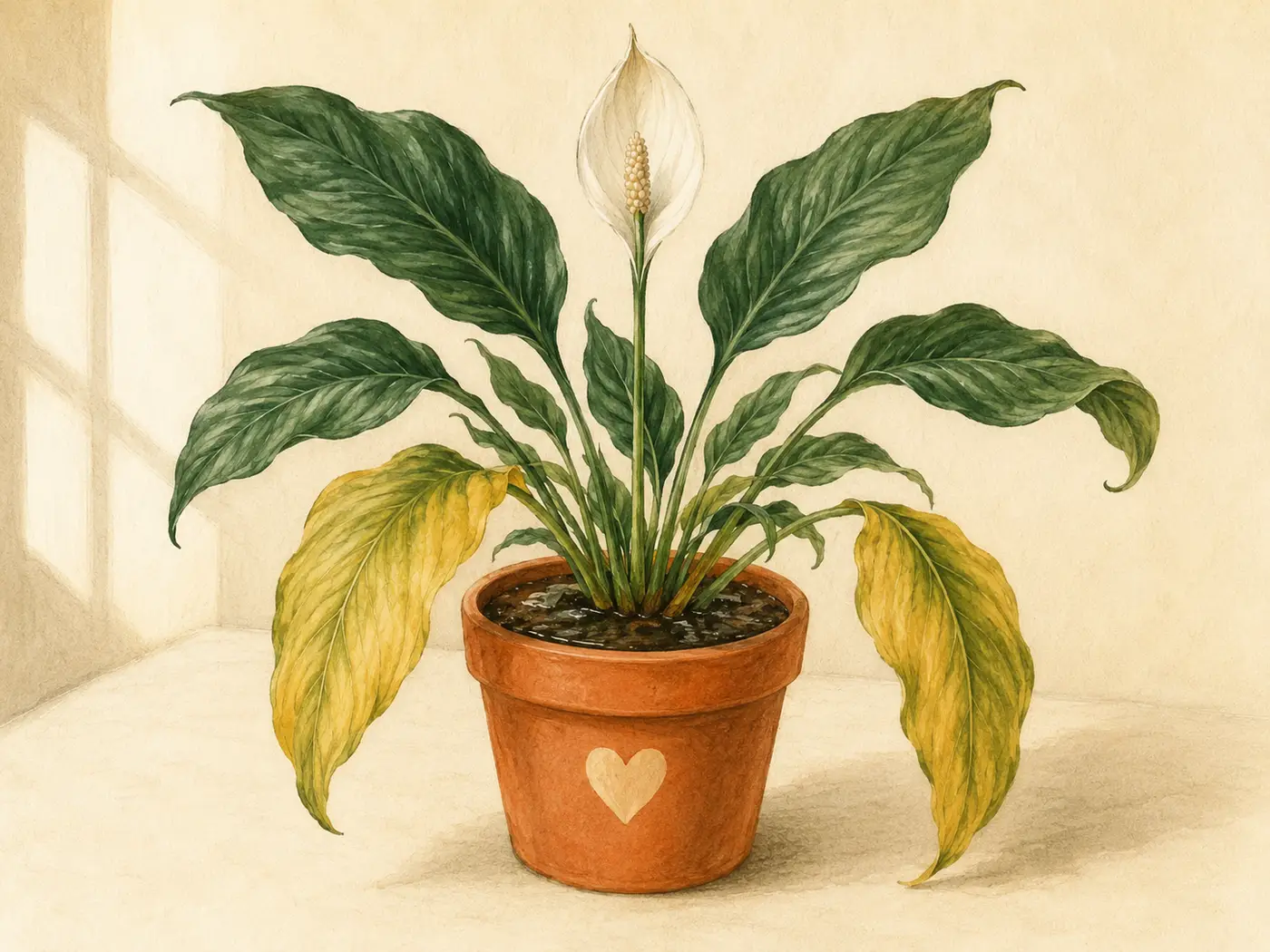
At a glance
- First check
- Soil moisture and drainage; do not assume every yellow leaf means overwatering.
- Other causes
- Old age, low light, mineral burn, cold draft.
- Reversible?
- The plant recovers, but yellow leaves don't turn green again.
- Action
- Check moisture first; pause watering only if the mix is wet.
Yellow leaf pattern decoder
The pattern of yellowing — which leaves, where on the leaf, and how fast — usually points to the cause faster than any single test:
| Pattern | Possible cause to check | First action |
|---|---|---|
| Yellowing with limp leaves; mix dry through the root zone; pot light | Possible drought stress | Water thoroughly and drain; check that the root ball actually wets |
| Multiple lower leaves yellow together; soil damp; pot heavy | Overwatering / early root rot | Pause watering; inspect roots if wet soil is paired with persistent drooping or a sour smell |
| One old outer leaf yellow; rest of plant healthy | Natural aging | Remove the fully yellow leaf and monitor the remaining foliage |
| Slow yellowing; pale new leaves; long petioles; no flowers | Low light | Move closer to a window |
| Yellow with brown crispy tip first; whitish soil crust | Possible salt buildup; check water and fertilizer history | Check drainage and roots before flushing; review water and fertilizer |
| Yellow patches turning black overnight; near a window | Cold draft | Move away from glass and AC vents |
| Yellow with sticky residue or webbing on leaves | Pests (mealybugs, spider mites) | Isolate; cleanup protocol |
| Yellow with crispy edges; recently fertilized | Fertilizer salt burn | Check drainage and follow fertilizer guidance; do not fertilize again while stressed |
| Sudden mass yellowing after a move or repot | Transplant / acclimation shock | Check roots and moisture if severe; otherwise keep conditions steady |
1. Wet soil and poor drainage
If multiple lower leaves are yellow at once and the soil feels constantly damp, excess moisture or poor drainage may be stressing the roots. Roots can't breathe in soggy soil; they suffocate, and the plant abandons leaves to conserve resources.
Fix: stop watering. Let the upper mix begin drying and check moisture deeper in the root zone before watering again. If you notice a sour smell, a soft crown, or drooping in wet soil, unpot promptly to check for root rot.
The fastest clue is the pot, not the leaf. A heavy pot, wet drainage holes, a sour smell, or a saucer that keeps collecting water all point to a moisture problem. If the pot has no drainage hole, move the plant to a draining pot as soon as possible.
2. Natural aging
One yellow leaf, on the outside, on an otherwise happy plant? That's just a leaf retiring. Snip it at the base.
Natural aging usually affects the oldest outer leaf one at a time. The rest of the plant should look firm, upright, and green. If several leaves yellow together, or new leaves yellow first, treat it as a care problem.
3. Low light
Light-starved peace lilies will sacrifice their oldest leaves to feed the rest. Pale, slow-growing, never blooming → move closer to a window.
Low-light yellowing is gradual. You may also see long petioles, smaller leaves, and soil that stays wet for too many days because the plant is not using water quickly. Move the plant one step brighter, then watch the next two leaves rather than expecting yellow leaves to recover.
4. Mineral / fluoride burn
Yellowing with brown tips can involve accumulated salts, inconsistent watering or other stress. Review water quality and recent fertilizer use before choosing a fix.
If salt buildup seems likely and the pot drains freely with healthy roots, flushing the mix can help remove excess salts. Avoid adding more water to a persistently soggy, unhealthy root ball. If dissolved minerals are implicated, check what your filter removes; ordinary filters do not all remove dissolved salts. Old damaged tissue will stay damaged.
5. Cold draft
Yellow patches that turn black overnight? Check for an AC vent or a leaky window.
What to do today
- Feel the soil two inches down and lift the pot to judge weight.
- Check the leaf pattern: one old leaf, many lower leaves, tips first, or black patches.
- Empty any saucer water and pause watering if the mix is damp.
- Move the plant to bright indirect light, away from cold glass and vents.
- Remove fully yellow leaves at the base so the plant can redirect energy.
Will yellow leaves turn green again?
No. Once a peace lily leaf turns fully yellow, it will not green back up. Recovery shows through new leaves, firmer stems, and the yellowing pattern stopping. This is why diagnosis matters: the goal is not to save the yellow leaf, but to stop the next one from yellowing.
When to inspect roots
Unpot the plant if yellowing is paired with drooping in wet soil, a sour smell, black mushy stems, or soil that remains wet for more than a week. A quick root check is less risky than letting a rotting plant sit. Healthy roots are firm and pale; rotted roots are brown, soft, and may slide apart when touched.
How to prevent the next yellow leaf
Give the plant a stable routine: bright indirect light, a draining pot, and watering based on the soil rather than a calendar. Empty saucers, avoid cold drafts, and feed lightly only during active growth. Most repeated yellowing comes from one of those basics being off by a little for too long.
For the cosmetic step of removing fully yellow leaves, see the pruning guide. If the plant arrived with yellow leaves from the store, the buying guide covers what to inspect before purchase. Mineral-driven yellowing (with brown tip first) usually traces back to water quality.
Yellow vs other discolorations
Not every off-color leaf is "yellowing." The cause and fix are completely different depending on which one you actually have:
- Pale green new growth — may be normal before a leaf matures; persistent paleness needs a light, root and nutrition check.
- Yellow with green veins — can suggest chlorosis, but the pattern alone does not identify a specific deficiency. Check roots and growing conditions before adding supplements.
- Yellow blotches between veins — has several possible causes; do not diagnose a magnesium deficiency from color alone.
- Yellow turning brown then black — past the saving point on that leaf; focus on stopping new yellowing.
- Bleached / whitish-yellow — sun scorch from direct light, not chlorosis.
When yellowing is normal
Mature peace lilies replace lower leaves regularly. Losing one outer leaf every couple of months on an otherwise healthy plant is part of normal aging — not a problem. The signals that aging is the cause:
- Only one leaf at a time yellows.
- It is always the outermost, oldest leaf.
- The center of the plant is firm and producing new growth.
- The pot is not waterlogged.
- The yellowing happens slowly over weeks, not days.
Together these observations support normal aging. Keep watching for a change in the pattern rather than treating them as a diagnostic checklist with a fixed score.
How fast is the yellowing happening?
- Hours to overnight
- Check recent cold, heat or chemical exposure. Timing alone does not identify the cause.
- 1–3 days
- Active root rot, severe drought, or chemical burn (fertilizer, softened water).
- 1–2 weeks
- Ongoing overwatering, low light, or pest pressure building up.
- Weeks to months
- Mineral accumulation, slow nutrient deficiency, gradual root binding, or simply aging.