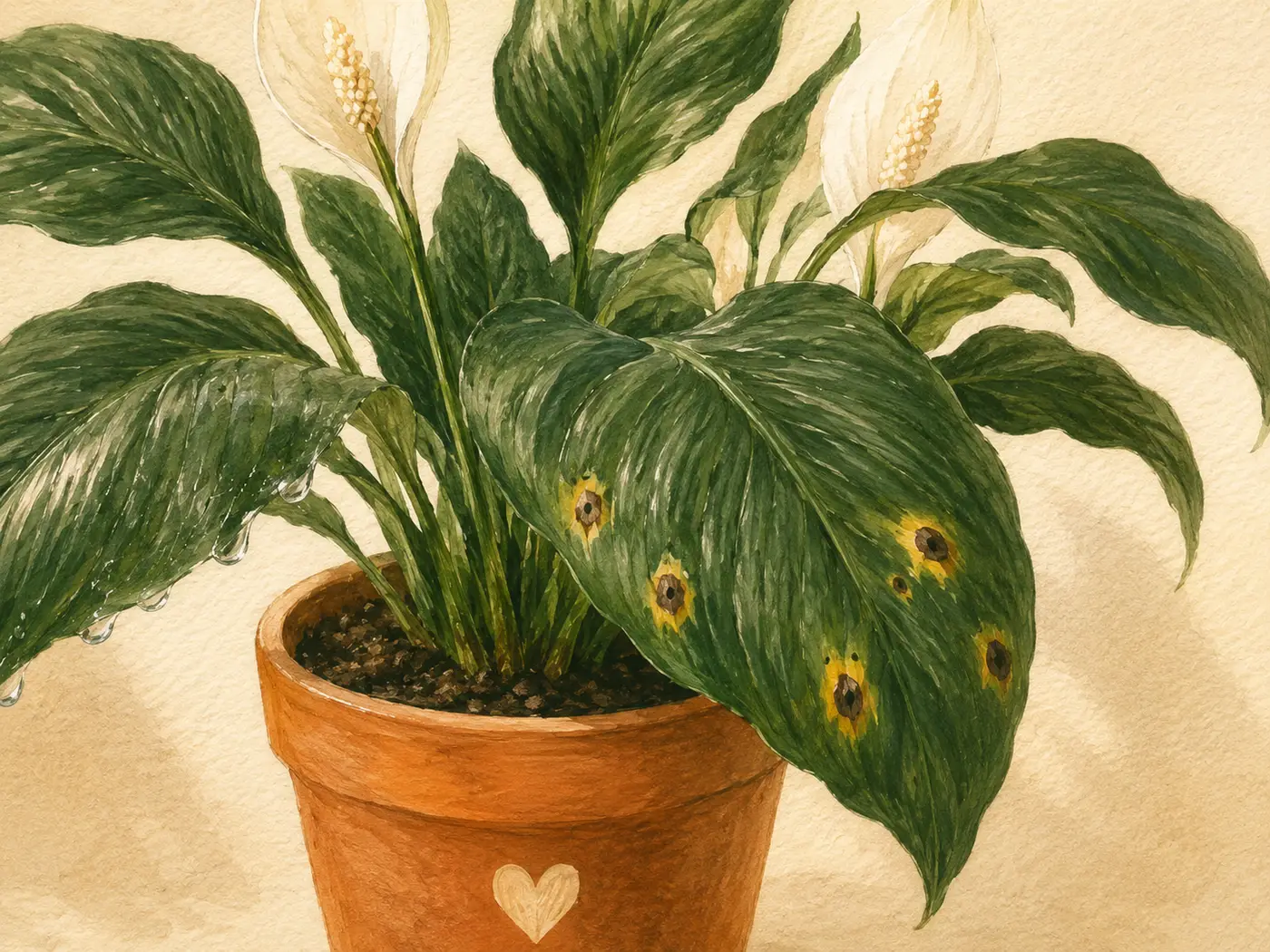
Leaf spot: brown halos with yellow rings.
Fungal disease, usually from water sitting on leaves.
At a glance
- Tell
- Round brown lesions, often with yellow halos
- Cause
- Bacteria or fungus thriving in wet leaf surfaces
- Treatment
- Remove affected leaves; copper fungicide; improve airflow
How to treat
- Remove and discard every spotted leaf.
- Stop misting. Water only at the soil.
- Apply a copper-based fungicide to remaining foliage.
- Improve airflow with a small fan nearby.
First confirm the pattern
Leaf spot usually appears as separate round or irregular marks, often with a darker center and a yellow halo. It is different from a dry brown tip, a sunburned edge, or one old leaf turning yellow. Pattern matters because each problem has a different fix.
Why wet leaves matter
Peace lilies like humidity, but they do not need leaves kept wet for hours. Constant misting, crowded foliage, cold rooms, and poor airflow can all keep leaf surfaces damp long enough for disease to spread.
How to remove spotted leaves
Use clean scissors and cut the affected leaf stem close to the base. Do not compost diseased leaves indoors. Wipe the scissors after cutting, especially if you move from a spotted leaf to a healthy one.
Aftercare
Water the soil, not the foliage. Give the plant bright indirect light and enough space for air to move around the leaves. If you use a fan, keep it gentle; the goal is air movement, not a cold blast.
When fungicide makes sense
If spots keep appearing after you remove damaged leaves and change the watering routine, use a labeled houseplant fungicide such as a copper product. Follow the label carefully and keep the plant out of harsh sun after spraying.
What if spots are not spreading?
Old mechanical damage, cold marks, or past water stress can leave spots that do not spread. If no new spots appear for several weeks and new leaves open cleanly, you may not need treatment beyond trimming the worst leaves and improving care.
Preventing repeat leaf spot
Clean dust from leaves, avoid crowding plants tightly together, stop routine misting in cool rooms, and remove spent blooms before they collapse onto foliage. Moderate humidity is useful; wet stagnant leaves are the problem.
When to isolate
Isolate the plant if spots are spreading quickly, appearing on several leaves at once, or showing up on nearby plants. Isolation gives you room to prune, treat, and watch without risking the rest of the collection.
Leaf spot vs brown tips
Brown tips usually begin at the leaf end or edge and point to water, humidity, salts, or fertilizer. Leaf spot appears as separate marks on the leaf blade. If you treat every brown tip like disease, you may overuse sprays and miss the real care problem.
Recovery signs
Existing spots stay marked, so judge recovery by whether new spots stop forming. A clean new leaf after several weeks is a better sign than an old spotted leaf looking unchanged.
Common treatment mistakes
- Continuing to mist while treating spots.
- Leaving badly spotted leaves pressed against healthy leaves.
- Spraying fungicide without improving airflow.
- Confusing mineral-burn tips with leaf disease.
When to check roots too
If leaf spots come with yellowing, drooping, or a sour smell from the pot, inspect the roots. Wet soil can contribute to both leaf disease pressure and root decline, so the soil condition matters as much as the spots.
Take a photo before pruning if you are unsure whether spots are spreading. A weekly comparison makes it easier to tell old cosmetic damage from an active disease.
Keep the plant out of splash zones after that. Water drops from sinks, showers, or crowded shelves can restart the same leaf-wetness problem.
New clean growth is the clearest sign that the new routine is working.
Keep that routine steady for several weeks before declaring the issue solved.
Sources & further reading
- University of Florida IFAS Extension — Spathiphyllum cultural notes.
- RHS plant database, retrieved May 2026.
- Missouri Botanical Garden — Spathiphyllum wallisii.